Peace and justice events throughout history:
The Wall of Hope
Peace & Justice
Resource Center - PJRC
Nonviolent efforts to bring about peace and justice are far more numerous than most people realize. Young people have been key participants in many such efforts. The PJRC Wall of Hope exhibit and its related activities and resources seek to honor the memory of these movements and heroes and to encourage social change efforts today.
The Wall of Hope includes roughly equal numbers of activities, heroes, and movements for peace (on blue labels), racial and ethnic justice (orange), freedom and independence (red), and social justice and the environment (green).
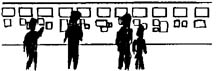
The Wall and/or its activities have been used with countless groups since the late 1980s. Many groups and classrooms have used a “how to” kit to create their own Wall of Hope and share its stories and insights widely in their communities.
Here then are over 100 inspiring and challenging examples of ordinary people struggling for peace with justice through nonviolent action. They encompass virtually every geographic area of the world, period in history and type of social concern:
1350 B.C.E. Hebrew midwives, in the first recorded act of civil disobedience, refuse to obey Pharaoh’s order to kill male Hebrew babies. After years of slavery in Egypt the Hebrew people leave in the Exodus, an experience of liberation central to Jewish and Christian understanding of God acting in history.
~600-520 As a teenager, Jeremiah is called to be a prophet, and like Amos, Isaiah and Micah, he criticizes the injustices of the day and pleads for the Children of Israel to make the pursuit of justice and care for the neighbor central to their lives.
~563-483 Gautama Buddha shares his insights that: “Better than a thousand hollow words, is one word that brings peace,” and “No one can find inner peace except by working, not in a self-centered way, but for the whole human family."
~500 Lao Tsu teaches the power of compassion, simplicity, and patience, e.g. he counsels that “In governing, don’t try to force issues or defeat enemies by force of arms. Violence, even well-intentioned, always rebounds on itself.” (Tao Te Ching, 30)
388 Aristophanes’ play Lysistrata depicts women on both sides stopping a war by withholding sex from their soldier-husbands.
26 C.E. Thousands of Jews protest symbols of the Roman empire which Jews consider to be idolatrous. When threatened with death, they offer their necks to the sword but will not budge. Pilate removes the offensive emblems.
1-33 Jesus lives a life of nonviolence and compassion for all without regard to age, social status, race, or gender, and is put to death for the threat he posed to the established order.
30-80 St. Paul and the apostles preach the Christian gospel of justice, nonviolence, and reconciliation. As Paul writes, "Do not be conformed to this world, but be transformed...Live in harmony with one another. Do not repay evil for evil. If your enemies are hungry, feed them." (Romans 12)
50-200 Pacifism is typical among early Christian communities, with members being encouraged to make a vow of nonviolence or required to leave the military. Church leaders opposed to killing, even by the government, include Arnobius, Basil the Great, Cyprian, Irenaus, Justin, Origen, and Tertullian.
340s Martin of Tours, a Roman army officer, renounces violence when he becomes a “soldier of Christ.” Martin Luther, Martin Niemoller, and Martin Luther King, Jr. are all named after him.
570-632 The prophet Muhammad, founder of Islam, emphasizes: ”Be steadfast, bearing witness in equity; and let not a people’s enmity incite you to act otherwise than with justice. Be always just, that is nearer to righteousness.” (Qur’an, ch.16 v.91)
1200 St. Francis of Assisi turns his back on wealth as a youth; lives a life of nonviolence and concern for others and for all creation. Animals are often blessed on his birthday.
1200s Thousands of women join women’s communities called Beguines that develop cooperative economic forms and offer leadership opportunities to women.
1520s Bartolome de las Casas, a West Indian landowner and priest, is outraged by the brutality of the Spaniards toward the Indians. He writes reports and makes several trips back to Europe in a life-long effort to convince the king and religious leaders to treat Indians fairly.
1537 The “Historic Peace Churches” – which oppose war for conscience sake – are founded, including Mennonites, in 1537; The Society of Friends, known as Quakers, in 1652; and the Brethren, in 1708.
1644 11 African American servants in New Amsterdam file a petition for freedom, the first recorded legal protest in what Europeans call the "New World."
1681 William Penn's Letter to the Delaware Indians leads to treaties that keep the peace between whites and Indians for two generations.
1758 John Woolman persuades the large Philadelphia Friends Meeting to condemn slave-holding by Quakers. He later writes "A Plea for the Poor," calling for an end to injustice and greed which he sees as the root of conflict.
1765-75 American colonists conduct 3 nonviolent resistance campaigns against British rule; they result in a condition of independence by 1775, a year before war is declared in 1776.
1780 Quakers start the first antislavery society in the United States.
1840s The Underground Railroad helps slaves escape to the northern U.S. or Canada led by “conductors” such as Harriet Tubman who led 19 groups to safety, despite her epilepsy and her own vulnerability as an escaped slave.
1846 Henry David Thoreau is jailed for refusing to pay taxes to support the Mexican-American War. He writes a powerful essay, “On the Duty of Civil Disobedience,” which influences Tolstoy, Gandhi, and generations of peacemakers.
1848 Lucretia Mott, along with Elizabeth Cady Stanton, organize the first women's rights convention.
1850 Hungarian patriots engage in nonviolent resistance to Austrian rule and eventually are able to regain self-governance for Hungary.
1854 Elihu Burritt advocates organized civil disobedience -- not just individual belief and activity -- to end the power of govern- ments to make war.
1867 2000 Chinese workers hired to build railroads in Western United States organize a week-long strike protesting inhumane and racist conditions.
1871 1000 women in Paris block cannons and stand between Prussian and Parisian troops, preventing war.
1873 Women celebrate the first "Mother's Day" originally a peace holiday as proposed by Julia Ward Howe.
1891 Ida B. Wells starts her lifelong anti-lynching campaign by setting up a newspaper, the Memphis Free Speech, to draw attention to brutal lynch mob murders of African Americans.
1898-1902 Thousands protest the brutal Spanish-American War; leaders include Mark Twain, author of A Connecticut Yankee in King Arthur's Court, The War Prayer and more on the folly of war.
1900s Beginning as early as the 1700s, the U.S. labor movement strives to secure economic justice, workers' dignity, and better working conditions. Among nonviolent methods used: strikes, picket lines, and worker organizing.
1901-05 Finns nonviolently resist Russian oppression, forcing them to repeal a law imposing a military draft.
1905 Mohandas Gandhi begins his first major nonviolent resistance campaign in Johannesburg, South Africa.
1909 The National Association for the Advancement of Colored People (NAACP) is formed to fight prejudice and discrimination; W.E.B.duBois, Ida B. Wells, and Mary Terrell are among the founding members.
1914 As World War I begins the Fellowship of Reconciliation is founded by a German Lutheran pastor and an English Quaker, "to keep the bonds of Christian love unbroken across the frontier."
1914-1918 Conscientious objectors to World War I number more than 4,000 in the United States. Although torture and brutality are common in prison and several men die, by their courage they make non-participation in war as a matter of conscience easier for future conscientious objectors.
1919-47 Mohandas Gandhi leads the struggle for Indian inde- pendence from British rule through nonviolent means such as the 1930 "Salt March" across India to the ocean where Gandhi and countless protesters gather salt in violation of British law, publicly evading oppressive British taxes.
Badshah Khan, a leader of the Pathans, a people with a strong warrior tradition, organizes a "nonviolent army," which numbers as many as 100,000 people, to oppose British rule and resolve conflicts. In the process he explodes 3 myths: that nonviolence can be followed only by those who are gentle; that it cannot work against ruthless repression; and that it has no place in Islam.
1920 After 75 years of struggle, the U.S. women’s suffrage movement achieves a constitutional amendment guaranteeing women the right to vote.
1923 20,000 women silk workers in Shanghai, China go on strike demanding a 10-hour work day.
1923 French and Belgian occupation of the Ruhr valley is ended after noncooperation by German citizens makes the occupation too costly, both economically and politically, despite severe repression.
1927 The Filipino Federation of Labor, the League of United Latin American Citizens (1928), and the Japanese American Citizens League (1930), are organized in the face of rising discrimination in U.S. society.
1930s Toyohiko Kagawa leads a movement in Japan to help the poor and to oppose growing militarism.
1933 The Catholic Worker is founded in NY by Dorothy Day, a reporter, and Peter Maurin, a self-taught French peasant. The movement and the Catholic Worker newspaper emphasize hospitality to the poor, pacifism, and voluntary poverty. Catholic Worker houses are organized in dozens of cities in the U.S.
1934 20,000 students participate in a one-day anti-war strike in the United States.
1933-1934 A group of pastors including Martin Niemoller -- a veteran of the German Navy in World War I -- forms the "Pastor's Emergency League." It support pastors who are part-Jewish or lose their salaries because of the Nazis.
1934 An official convention of Lutheran and other delegates unanimously passes the Barmen Declaration asserting the gospel's independence of Nazi authority. The declaration leads to the founding of the Confessing Church, which, though not perfect, became the most effective anti-Nazi group in Germany.
1940-45 Finland saves all but six of its Jewish citizens from Nazi death camps through nonmilitary means.
6,500 of 7000 Danish Jews escape to Sweden, most of the rest are hidden, aided by the people and tips from within the German occupation force.
A rail worker strike in Holland almost shuts down traffic from Nov. 1944 until liberation in May 1945 despite extreme privation to the people -- as is portrayed in the Diary of Anne Frank.
Public resistance in Norway undermines Nazi plans; e.g., teachers refuse to teach Nazi propaganda. Romania at first persecutes Jews, then refuses to give up a single Jew to the death camps.
Thousands of Bulgarians march in demonstrations, hide Jews, and send countless letters protesting anti-Jewish measures. Bishop Kiril threatens to lead civil disobedience and lie down on the tracks in front of trains. All Bulgarian Jews are saved from Nazi death camps.
After the war, German generals admit their complete inability to cope with such nonviolent strategies.
1942 German students form the White Rose resistance move- ment against the Nazi regime and distribute thousands of leaflets which expose the nature of the Nazis and its treatment of Jews and urge “obstruction of the war machine by passive resistance,” including sabotage. Several of its leaders are arrested and beheaded by the Nazis in 1943.
1943 Lutheran youth leader, pastor, and theologian Dietrich Bonhoeffer is jailed for his efforts on behalf of German Jews. He had refused an offer to live and teach safely in the United States and returned to Germany in 1935 to lead an underground seminary and work in the resistance. He is hanged by the Nazis in 1945 after he is linked to a plot against Hitler.
1944 The Central American dictators Jorge Ubico (in Guatemala) and Maximiliano Martinez (in El Salvador) are ousted as a result of nonviolent civilian revolts and general strikes. Between 1931 and 1961, eleven Latin American presidents leave office as a result of civil strikes.
1945 Claude Eatherly pilots the plane that drops the first atomic bomb used in wartime. He later comes to regret his involvement in the bombing of Hiroshima and speaks widely about the horrors of modern weapons and war.
1945 The United Nations is founded to resolve disputes before they result in war. Since then, the UN has developed agencies and programs on arms control, human rights, the environment, hunger and development, indigenous peoples, peacekeeping, refugees, children and women to name a few.
1950s A priest and several students in the Basque region of Spain begin a cooperative factory. It grows into a network of 170 worker-owned-and-operated cooperatives called Mondragon, with 21,000 well-paying jobs, a bank, chain of stores, and technical schools. They develop many creative democratic processes emulated elsewhere.
1955 500,000 women in Indonesia demonstrate for women's rights on International Women's Day.
1955 Rosa Parks is arrested after refusing to give up her seat and move to the back of the bus where blacks were required to ride. The black community launches the Montgomery bus boycott, led by Dr. Martin Luther King, Jr. After a year of creativity in coping with the hardship that ensues, the boycott succeeds, revitalizing the civil rights struggle in the U.S.
1957 Despite threats to their lives, Daisy Bates, Elizabeth Eckford, and seven other young students become the first African Americans to attend the previously all-white Central High School in Little Rock, Arkansas.
1958 Ken Caulkin, a founder of the Student Peace Union, is run down by a truck and seriously injured in a protest against the first Atlas missile base being built in Cheyenne, Wyoming.
1959 The Southern Christian Leadership Conference (SCLC) is organized by Martin Luther King, Jr., Ella Baker and other black leaders. It becomes the most influential African American civil rights organization.
1959 Septima Clark sets up Freedom Schools all over the South to teach black history and to train African Americans as voters and community leaders.
1960 Four black students “sit in” at a Woolworth lunch counter to protest the rule that only whites can eat there. The nonviolent tactic of "sit-ins" spreads in campaigns to desegregate rest- rooms, movie theaters, restaurants, and libraries.
The Student Nonviolent Coordinating Committee (SNCC) is formed to mobilize young people and connect black & white youth using nonviolent direct action methods like “sit-ins.”
1961 Young Freedom Riders – black and white – protest discrimi- nation on buses. A bus is burned in Alabama, riders are attacked in Birmingham, and spend 40 to 60 days in jail in Jackson, Mississippi. Six months later, the U.S. government bans racial segregation on buses, trains, and transport facilities.
1961 Amnesty International is founded to document and protest torture and capital punishment. It gains over a million members by 1980 with many high school and college chapters.
1963 The March on Washington is the largest demonstration to date bringing over 250,000 people to the Lincoln Memorial. Martin Luther King, Jr. offers his “I Have a Dream” speech.
1963 Limited nuclear test ban treaty is signed by Pres. Kennedy after six years of demonstrations by peace groups and growing concern by the public about health hazards of nuclear testing.
1964 The Freedom Summer project recruits 700 young people to help register voters in Mississippi. Though three volunteers -- Goodman, Schwerner and Cheney -- disappear as training begins and are later found murdered, almost all of the volunteers continue their work.
1964-73 Draft card burning marks growing resistance to the U.S. war in Vietnam; millions of people join in demonstrations, draft counseling, tax resistance, civil disobedience, street theatre, and other forms of protest.
1964 500,000 pupils stay home from school in New York City to protest racial segregation.
1965 The United Farm Workers union launches a grape boycott led by Ceasar Chavez and Dolores Huerta to permit farm- workers to organize for decent pay and conditions. They had not been allowed to form unions like other workers. Many thousands of individuals, schools, and churches support the boycott.
1965 Because of the enthusiasm and activism of many African Americans -- like Fannie Lou Hamer, a sharecropper who simply wanted to vote. Congress passes the Voting Rights Act.
1968 Philip and Dan Berrigan and seven other Catholic priests and lay people destroy 378 draft files in the Catonsville, Maryland draft board and await arrest. The protest sparks dozens of similar acts of civil disobedience, and their action and court room statements form the basis of Dan's eloquent drama, The Trial of the Catonsville Nine.
1965 The growing Liberation Theology movement in Latin America emphasizes solidarity with the poor and oppressed; Helder Camara, Gustavo Gutierrez, Juan Segundo, Jon Sobrino, and later Elsa Tamez are among its leaders.
1969 Greenpeace adopts nonviolent direct action methods to dramatize its message to protect the environment. Its creative tactics included sailing boats into nuclear testing and whaling areas and hanging banners from bridges.
1970 The killing of four students by the National Guard at Kent State University sparks strikes and protests at thousands of colleges. More than a million people join Vietnam protests for the first time. A few days later, two African American students are killed at Jackson State College.
1970 The first Earth Day is held in cities around the United States to focus public attention on environmental issues.
1971 At the age of 90, Jeanette Rankin leads 8000 woman on a march to the Pentagon against the Vietnam War. 1000 veterans protest the war; many throw their medals onto the Capitol steps.
1972 The Trail of Broken Treaties march occupies the Bureau of Indian Affairs offices in Washington, DC to dramatize Native American needs.
1973 Bread for the World is established to educate, organize and lobby on hunger issues and before long has 45,000 members. It successfully lobbies the U.S. Congress to pass the Right to Food Resolution in 1976, the Africa Relief and Recovery Act in 1984 and to expand funds for U.S. and global hunger programs.
1975 Groups defending the rights of indigenous peoples are organized around the world to protest logging or stealing of their land, and other abuses. More than 1000 such groups are formed by the mid-1980s.
1976 60,000 join Peace People demonstrations in Belfast and Dublin. Mairead Corrigan and Betty Williams receive the Nobel Peace Prize for their efforts at nonviolent reconciliation in Northern Ireland.
1977 "Mothers of the Plaza" buy a newspaper ad in Argentina to publish the names of mothers and pictures of 230 "disappeared" that is people kidnapped, tortured, and/or killed by the military.
1977 The Nestle boycott leads to a UN World Health Organiza-
tion agreement restricting promotion and sale of infant formula in poor countries. Infant formula is less healthy than breast- feeding due to a lack of clean water and its high cost.
1979 A Gay Rights March draws 100,000 demonstrators to Washington, DC to protest discrimination against homosexuals.
1980 Adolfo Perez Esquivel receives the Nobel Peace Prize for the work of Servicio Paz y Justicia; a group he had founded to intervene on behalf of human rights victims across Latin Amer.
1980 Archbishop Oscar Romero of El Salvador is murdered while celebrating mass. He had icome to identify with the poor, and to urge soldiers not to participate in violence.
1980 Solidarity movement is founded in Poland. Repressed by the government, in a few years it is widely declared dead even by many Western correspondents. In 1989 it wins every available seat in Parliament and now governs the nation; yet it committed not a single violent act despite the killing of 100 of its members.
1980s Witness for Peace sends thousands of Americans to Nicaragua in a 'shield of love' to help stop violence by U.S.- backed "contra" guerrillas... 80,000 U.S. citizens sign a "Pledge of Resistance” vowing to commit civil disobedience if the U.S. invades, helping avert military action. 300 churches offer Sanctuary to protect Central American refugees from deportation.
1981 Protests against U.S. cruise missiles based at Greenham Common in England begin. At its peak, more than 8,000 women live in tents outside the base, demonstrating and committing civil disobedience. In one protest, 30,000 people encircle the base.
1982 750,000 people gather in NY for the largest disarmament protest in U.S. history. During the 1980s a wide variety of nonviolent methods are used from demonstrations to peace quilts, nuclear freeze petitions to street theatre. Over 37,000 people are arrested for civil disobedience actions protesting the threat to use nuclear weapons. University Peace Studies programs grow from two colleges in 1972 to over 300 by 1987.
1982 Sister Helen Prejean becomes a pen pal to a prisoner on death row. She later writes a powerful and moving memoir on her experience entitled, Dead Man Walking, which is made into an award-winning film.
1984 The book I, Rigobertu Menchu details the struggle of Guatemalan women in the face of the U.S.-supported military government that killed and tortured more than 100,000 people. Rigobertu Menchu receives the Nobel Peace Prize in 1992.
1984 Linda Stout, a tenant farmer's daughter, creates Piedmont Peace Project to organize rural poor for jobs, services, peace, and low-income empowerment; she later writes Bridging the Class Divide.
1986 The nonviolent People Power in the Philippines brings down the oppressive Marcos dictatorship. After a long period of protests, demonstrations of tens of thousands of people prevent a military response from succeeding. It inspires movements in Asia, South Africa, Eastern Europe, and elsewhere.
1986 The Palestinian Intifada, or "resistance" to Israeli military occupation begins. Contrary to many media reports, it used mostly nonviolent means.
1987 3,000 people gather on Mother's Day at the Nevada Test Site to protest preparations for nuclear war; the U.S. had detonated 1000 nuclear explosions between 1945 and 1990, more than all other nations combined.
1988 Black and white church leaders in South Africa unite to condemn apartheid in an Emergency Convocation and call churches to active nonviolent resistance .
1988 Well-known Palestinian nonviolent activist Mubarak Awad is expelled from Israel, despite pleas from President Reagan and the U.S. ambassador who says, "You need more Awads in Jerusalem, not fewer."
1989 Hungary, Poland, Czechoslovakia, Bulgaria, and East Germany all win freedom from Soviet control by nonviolent means. Nonviolent independence movements within the Soviet Union are launched in Latvia, Lithuania, Estonia, Georgia, Armenia, Molodavia, and the Ukraine.
1989 Romanian secret police attempt to arrest Rev. Laslo Tokes; his parishioners jam the streets, light candles, and refuse to move. The crowd grows to 50,000 in the city center. Violent suppression by the government sparks the revolution that overthrows the dictator Ceausescu.
1989 The Chinese government crushes a nonviolent student protest at Tiananmen Square but not before images are televised around the world such as an unarmed young man stopping a column of tanks.
1989 Student protests lead 20% of U.S. universities to fully withdraw investments from corporations with ties to South Africa; almost 60% support the divestment campaign.
1990 Disabled demonstrators at the U.S. Capitol building demand passage of a bill guaranteeing their civil rights. 60 people highlight their demands by crawling out of their wheelchairs and up the Capitol steps.
1990 King Birendra of Nepal yields to protests that topple his government and grants multi-party democracy, a parliamentary system, and freedom of speech, religion, press, and assembly.
1990-1991 Demonstrations in 20 cities protest U.S. buildup to war against Iraq; polls show the majority of Americans support nonviolent resolution of the conflict. Over 2000 young soldiers seek conscientious objector status. After the war, support grows for a Code of Conduct to end U.S. arms sales to dictators who amass weapons to invade neighbors or repress their people.
1991 Russian demonstrators in the tens of thousands surround the Moscow White House (their parliament building) to protect President Boris Yeltsin from a coup that fails despite command of four million soldiers and thousands of tanks and aircraft.
1992 Demonstrations and educational events around the world turn the 500th anniversary of the arrival of Columbus into a classroom on the plight of native peoples and the effects of colonialism.
1992 60,000 people attend an anti-war rock concert in Belgrade, Serbia to protest war in the former Yugoslavia; in Stara Moravica, a solidarity action is held in support of 83 young people who refuse to serve in the military. Even under Serbian shelling in Sarajevo, daily nonviolent protests take place.
1994 Nelson Mandela is elected the first black President of South Africa, just four years after he is released from jail.
1995 Million Man March by African Americans in Washington, DC highlights constructive efforts of black men and challenges them to fight racism and injustice in their communities back home.
1995 The human rights activist in Burma, Aung San Suu Kyi, is released from six years of detention; her political party had won an overwhelming victory in 1989 but wasn’t allowed to take office. She received the Nobel Peace Prize in 1991.
1996 Unmet needs of children is the focus of the Stand for Children march in Washington, DC led by Marion Wright Edelman of the Children’s Defense Fund along with local organizers and advocacy groups.
1998-99 Thousands of churches, schools, and groups pass resolutions endorsing the Nobel Appeal for Peace “For the Children of the World.” The UN designates the years 2001-2010 as the Decade for a Culture of Peace & Nonviolence. Over 74 million people sign a pledge of nonviolence by 2001!
1999 Over 50,000 people participate WTO protests in Seattle during World Trade Organization meetings. Lutheran Peace Fellowship youth hand out 8,500 flyers calling for justice for poor and working people, basic changes in the role of the World Trade, and nonviolence in the protests.
2002 Protests escalate against the Israeli Wall separating Jewish and Palestinian areas often putting barriers between Palestinians and their land, jobs, relatives, and neighbors.
Rachel Corrie, a 23-year-old American peace activist, becomes a symbol of resistance when she is killed in March by an American-made bulldozer in Gaza while nonviolently protesting the destruction of the homes of Palestinians.
2003 In March alone, more than six million people around the world protest plans of the US government to launch a war on Iraq that violates morality and international law, and is promoted by reasons that prove inaccurate such as a major new threat of Iraqi weapons of mass destruction.
2005 In a mass participation fast, concerned Americans express their remorse and penitence for the failure of their elected officials in Congress to follow up with effective action on their declaration of genocide in the Sudan.
2006 On May 1, over 1,500,000 people take part in the largest immigrant rights protest in U.S. history. May Day, which for 60 years has been a celebration of the contributions of working people around the world, becomes an annual event to push for comprehensive immigration reform.
2007 In just a decade, citizen lobbying leads to canceling of more than $120 billion of debt in developing countries, in what came to be called the Jubilee movement. Since 1986 the world’s 66 poorest countries paid $230 billion in debt service, more than they received from donor countries in that time.
2008 Chinese troops and security forces use gunfire to quell protests in Tibet, led mostly by young Buddhists monks. The largely nonviolent demonstrations against Chinese rule of Tibet, with leadership from the Dalai Lama, occur just weeks before the summer Olympics begin in China.
2008 Nuclear disarmament moves further into the mainstream as former “cold warriors” Henry Kissinger, George Shultz, William Perry, and Sam Nunn call for the complete elimination of nuclear weapons in a Jan. 15th Wall Street Journal article"Toward a Nuclear-Free World."
2009 More than four million Americans, many of them youth, have joined the ONE Campaign, Bread for the World, and other groups to fight extreme poverty and preventable disease, especially in Africa. They seek to hold world leaders of 191 countries accountable for commitments they made in 1999 to cut extreme poverty and hunger in half by the year 2015, and for support of seven other Millennium Development Goals.
2009 The Obama administration takes office with a federal budget that spends $686 billion on the military but less than $20 billion each on diplomacy and development. Citizen groups advocate major changes in a budget that spends so little on nonviolent approaches to conflict and on underlying causes of conflict.
2009 Millions of people from all walks of life take to the streets to protest the elections in Iran for what they regard as inaccurate or even fraudulent handling of ballot results.
Dec. 2010 Protests in Tunisia attract widespread support and lead to the fall of the government a month later. They spark a wave of protests, from Algeria to Yemen, focusing on the lack of political freedom and jobs, and on government repression and corruption. Before long these protests are referred to as “The Arab Spring."
Jan. 2011 Protests and acts of civil disobedience in Egypt capture world attention. Demonstrations in Tahrir Square often number over 100,000 and lead to a long-term occupation. They lead to the fall of the Mubarak government in late February.
Major uprisings also occur in Bahrain, Syria, and other countries. While much about Arab Spring protests is spontaneous, many protest leaders had learned from nonviolence workshops, analyses by Gene Sharp and others and even a US civil rights comic book.
2011 Occupy Wall St. demonstrations in NY City protest the large inequalities of wealth, income, and access to services, as well as corporate corruption, greed, and influence over government. The protest sparks Occupy activities in over 1000 communities in the US and 900 cities around the world. The protests utilize many nonviolent tactics under slogans such as, "we are the 99%."
2012 The shootings of 20 first graders and 6 teachers in Newtown Conn. spark the largest organizing efforts in years for gun control, e.g. to expand background checks, limit assault weapon sales….
And what will we add to the story of compassion and nonviolence, of justice and peace?
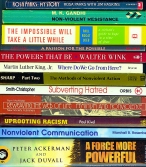
Especially useful sources of information relating to the Wall of Hope include: Peter Ackerman and Jack DuVall, A Force More Powerful; Erica Chenoweth and Maria J. Stephan, Why Civil Resistance Works: The Strategic Logic of Nonviolent Conflict; Robert Cooney and Helen Michalowski, The Power of the People: Active Nonviolence in the US;Staughton Lynd and Alice Lynd, eds., Nonviolence in America: A Documentary History; Pam McAllister, You Can't Kill the Spiritand This River of Courage; Michael True, Justice Seekers, Peace Makers, and To Construct Peace; Walter Wink, Engaging the Powers and The Powers That Be; Stephen Zunes, Nonviolent Social Movements… See Glen Gersmehl, Social Movements, one of 70 PJRC Resource Guides. |
The Wall of Hope grew out of conversations and workshops with young people, many of whom felt discouraged by the priorities and heroes of our culture. Beginning in 1988, students chose most of the 120 stories and 400 photos and drawings for the Wall. It seeks to dramatically illustrate the creativity and effectiveness of nonviolent responses to violence and injustice throughout history and around the globe.
The exhibit has traveled across the U.S. and Canada to over 600 schools, conferences, churches, groups, and events attended by over 150,000 people. The Wall of Hope and its activities and resources were originally developed by the Peace & Justice Resource Center which has shared it freely: Hundreds of classes and groups have used our free “how to” kit to create their own Wall of Hope, and/or a dozen Wall activities for exploring the potential of nonviolent social change.
The Wall of Hope was further developed by Lutheran Peace Fellowship, which later renamed it “The Path of Hope,” bringing it to a wide range of conferences, churches, and events, such as Youth Gatherings where it inspired tens of thousands of young people (check out Path resources at: www.lutheranpeace.org). The San Antonio PeaceCenter has exhibited widely their own version of the Wall, posting it with graphics on their website under the name, “The Great Peace March” (see: www.salsa.net/peace).
We’d love to receive your reactions to the Wall of Hope, and your ideas for additions, updates and action. The PJRC & these other groups welcome your partnership in sharing the gifts of justice, peace, and welcoming community in our troubled world.
For other Wall of Hope and nonviolence resources, and to connect with the community of peacemakers that is the PJRC, please contact us at:
1710 11th Ave., Seattle, WA 98122, 349-2501 (area code 206)
pjrcbooks@hotmail.com www.pjrcbooks.org